
Humane – a longevity
deal platform for investors
We grade the sport, longevity, preventive-health and foodtech universe on clinical evidence and unit economics — so a small circle of institutions can invest on data, not instinct.
Global longevity market — third-party market data and internal calculations.
of dealflow is early-stage — where evidence is thinnest and most calls are still made on instinct.
behind AI in capital-market maturity. In AI, late rounds absorb ~80% of venture dollars — this niche is only starting to grow.
Four markets are converging into one investable category.
Sports science, performance analytics, recovery tech, team & athlete services.
Clinics, diagnostics, biomarkers, healthspan therapeutics, NAD+/senolytics.
Wearables, continuous monitoring, precision nutrition, employer health, mental health.
Functional and medical nutrition, personalised diets, gut health, food that carries a health claim we can test.
Judgement, on subscription.
For family offices and HNWI, strategics and corporates, and PE funds, investing on their own account.
Subscription research
Clients pay for coverage and judgement, monthly or annually. Revenue is recurring and independent of deal outcomes.
A grading system
Every tracked company carries two scores: clinical evidence and unit economics. Refreshed quarterly and versioned.
A deal desk
The best-graded opportunities are packaged as decision-ready memos. Clients act on them on their own account.
A fund
No committed capital, no LPs, no management fee, no deployment pressure, no fund-life clock forcing bad entries.
A broker
We do not solicit investors for issuers or take success fees on capital raised. See the regulatory note.
A generalist database
One niche, covered exhaustively. Depth is the product; breadth of sectors is what we deliberately give up.

When green appears on our map, it means one thing: invest-grade.
Every grade has a paper trail.
What a subscriber opens: the grade, the memo behind it, and everything that has moved since.
Ten questions, two answers, one grade.
Five questions about the evidence, five about the business, each scored against a written anchor, so the same company gets the same grade whoever reads it. The two totals combine by geometric mean: a strong paper does not rescue a company nobody pays for, and a strong business does not rescue a claim nobody has tested.
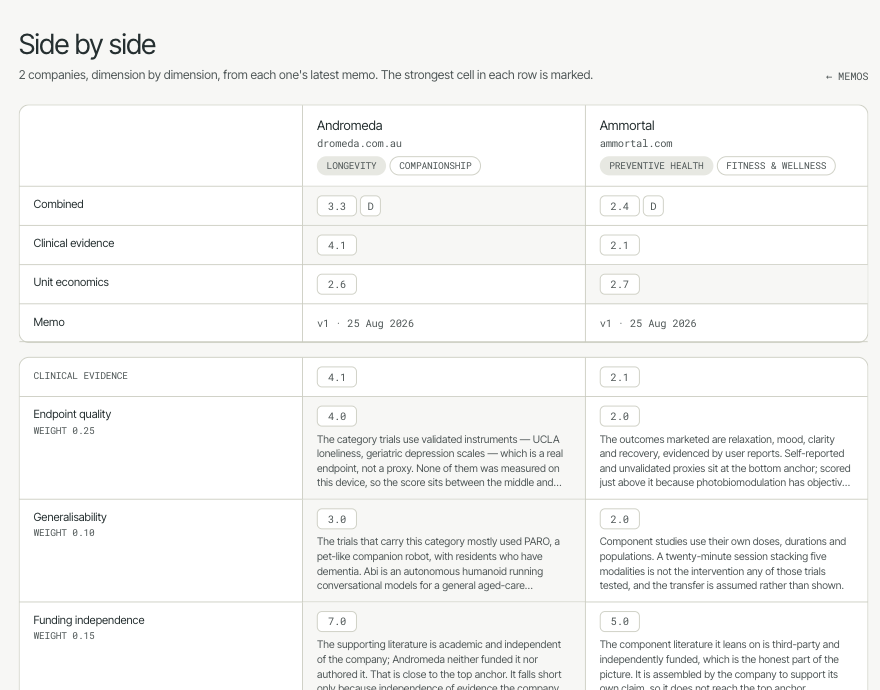
Every number has its reason next to it.
Each of the ten scores comes with the rationale and the studies it rests on, so a grade can be checked line by line instead of taken on trust. One named analyst signs it. When a score moves later, the reason moves with it, and the earlier version stays on the record.
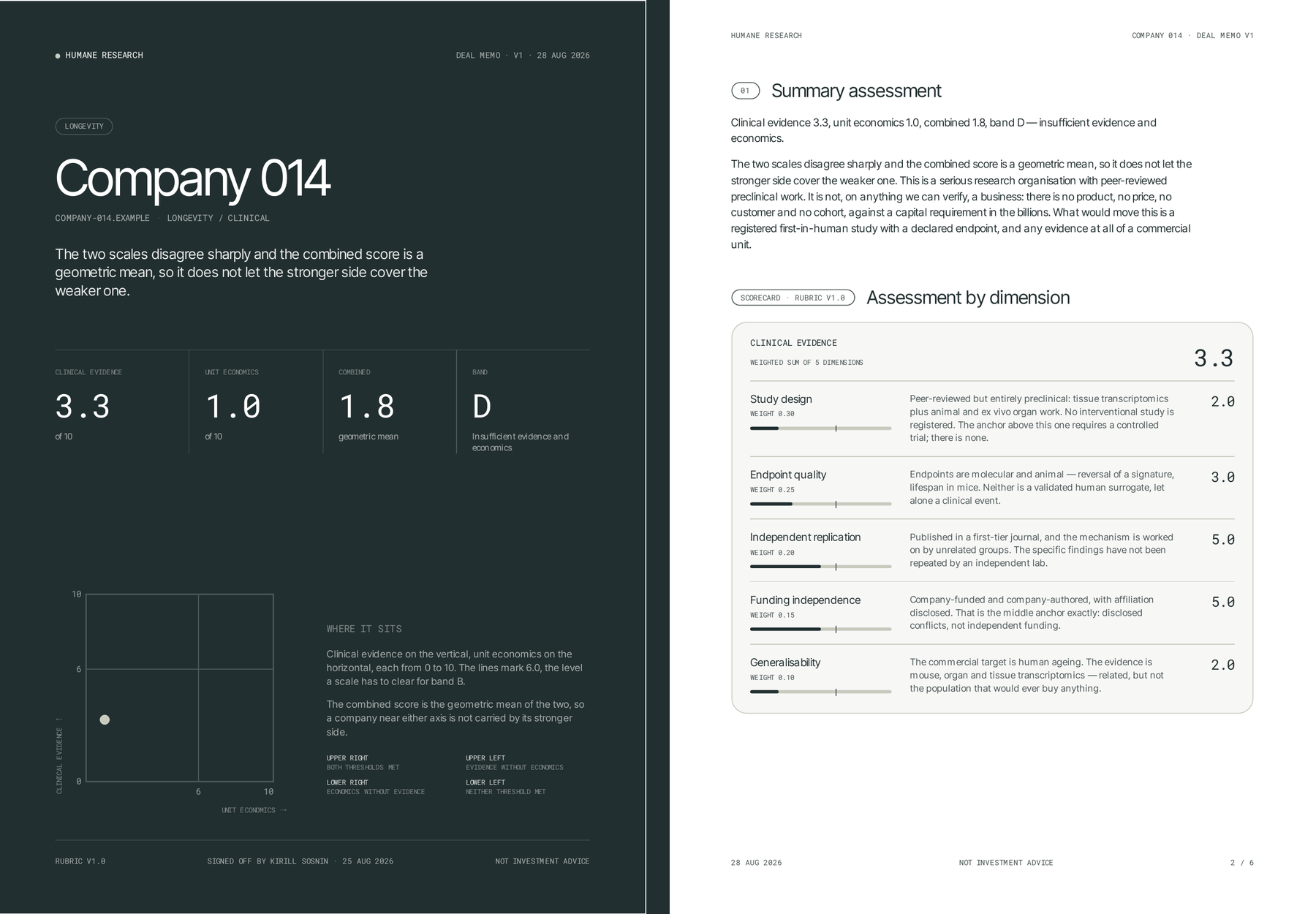
The memo is the database, printed.
Cover, scorecard, what moved since the last version, sources and disclosure, all drawn from the record on the day it was signed. Read it as a page in the portal or take the PDF; earlier versions stay beside the new one, so you can see exactly what changed and why.
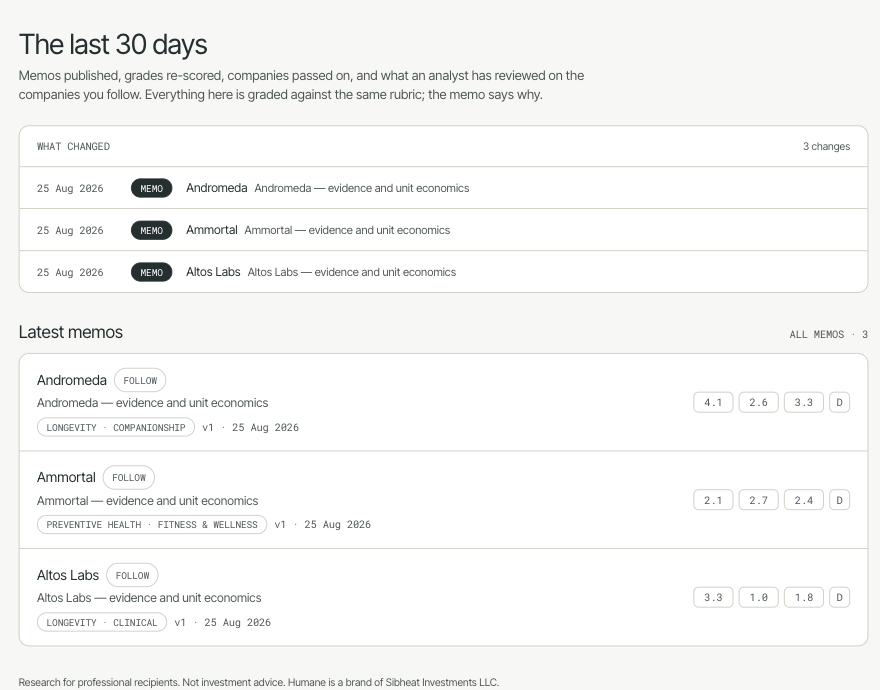
The whole market, in one place.
Every memo, the quarterly letter, the pass list with our reasons, and the shape of each segment: how many companies we graded and how the grades fall. Put two to four companies side by side. Follow a company or a segment and a weekly note tells you what changed: new memos, re-scored grades, what we passed on and why.
From 5,000 companies to a handful of decisions.
Great science, broken model. Watch for a strategic buyer.
Invest
Strong evidence and economics. This is the deal memo pool.
Neither. ~60% of the universe, including most viral brands.
Sells well, evidence thin. Regulatory and reputational risk.

Feedback loop: client questions, portfolio gaps and passed deals re-prioritise next quarter's coverage
Nothing in our universe is older than 90 days.

Six rules that keep the grades honest.
The rules are enforced in the software.
A signed grade stays as it was. A second opinion becomes a second version, kept beside the first.
One analyst puts their name to every grade, and the name travels with the memo.
Every graded company returns to the desk on a fixed clock, quiet quarter or not.
A trial is registered, a paper comes out, a clearance is granted, and it is on the company's record within the day.
The companies we declined, with the reason, on a list anyone can read.
Who changed what, when, and what they wrote at the time.
What lands in your inbox.
- Quarterly landscape map of the niche
- Full graded database, 500+ names
- Monthly written market note
- 4 analyst hours per month
- Deal memos on a 15-day delay
- Everything in Coverage
- Deal memos at publication, first look
- Two deep-dive researches per year
- Platform access: the scorecard behind every memo
- Direct analyst line, 48h SLA
- Everything in Partner
- Custom coverage mandate & watchlist
- M&A target screening and outreach
- Board-ready diligence packs
- On-site quarterly review
Questions we hear from allocators.
On ten questions: five about the clinical evidence, five about the business. Each is scored from 0 to 10 against a written anchor, so the same company gets the same score whoever reads it. The two totals combine by geometric mean into one grade and a band from A to D, and every graded company comes back to the desk within 90 days.
Both, in a fixed order. A model reads everything on the record, the trials, the papers, the filings, the company’s own claims, and produces two independent draft scores. An analyst then scores every dimension themselves, writes down where they disagree and why, and signs. No grade is published without a named analyst’s signature. The model makes the reading faster; it does not make the call.
Most of what we grade is used in training rooms, in clinics and on wrists, so we ask the people who use it: athletes and coaches, physicians, clinic operators, distributors. What they tell us goes on the company’s record as evidence next to the trials, and it can move a score. When it does, the memo says so.
The registries are watched daily: a new trial, a paper, a clearance or a recall lands on the company’s record the day it appears. If it changes the picture, the company is re-scored and a new version of the memo says exactly what moved and why. Earlier versions stay beside it.
No. Our revenue is the subscription and, occasionally, fixed-fee diligence mandates. We do not solicit investors for issuers — which is exactly what keeps the research conflict-light.
A quarterly landscape map, the re-scored database of 500+ names, a monthly written market note and 20–30 deal memos a year.
Humane sells subscription research and analysis. We are not a fund and not a broker: we hold no client capital, do not solicit investors for issuers, and take no success fees on capital raised. Nothing on this site is investment advice or an offer of securities.